 |
|
| Browse | Ask | Answer | Search | Join/Login |
|
|
||||
|
What are Schedule 40 and Schedule 80 ratings for pipe?
Ok, pvc is temperature restricted to 140 F so no hot water, cpvc can be used in the house. What is schedule 40 and schedule 80?
|
||||
|
|

|
||||
|
In the United States, "Schedule" refers to the thickness of the pipe wall and, therefore, how much pressure it will hold. In most aquaculture applications, Schedule 40 is used because:
1. It works for most applications and is readily available. 2. In small quantities, it is only slightly more expensive than the thinner wall Schedule 120. 3. The wall is thick enough so that it will not distort when walked on. 4. From 1/2" to 2", it is rated at no less than 140 psi at 73°F. The highest pressure typically found at any facility is 65 psi, which is the average city water supply. Schedule 80 is rated at no less than 200 psi at 73°F (up to 2") and is usually gray (similar to the Schedule 40 pipe used for electrical conduit). There are very few reasons to ever need such a heavy, costly pipe for aquaculture. The outside diameter (O.D.) is the same on Schedule 120, 40 and 80, so an expensive Schedule 80 fitting could be used on Schedule 120 or 40 pipe, if that's all that was available. As the wall of the pipe gets thicker, the inside diameter (I.D.) gets smaller. With fittings, the outside diameter gets larger. The main reason to use Schedule 80 is if it is mandatory in your area for specific applications but it can also be used on cold water loops to help insulate. <source> |
||||
|
|

|
||||
|
I agree with RickJ, he have described very well I am attaching the following links just for information, Thanks. Best Regards, John Nominal Pipe Size - Wikipedia, the free encyclopedia PVC and CPVC Pipes - Schedule 40 & 80 |
||||
|
|

|
||||
|
Schedule 40 in term of PSI , how much is it?
|
||||
|
|

|
||||
|
Hi Dominicano:
The info. above is not correct. I think Rick meant to say that maximum temperature rating is 140 F... but not maximum working hydrostatic pressure... ;) Cellular core PVC is considered a NO PRESSURE PVC... so not to be used for pressure applications. The correct answer depends on the size of the schedule 40 PVC pipe. For example at 75 degrees F, 2" sch. 40 PVC pipe can work with liquid up to 280 PSI, but 3" is only rated for 260 PSI and 4" PVC for only 220 PSI, etc. These are MAXIMUMS and again are NOT for schedule 40 cellular core DWV type PVC. Check it out at: http://www.charlottepipe.com/Documen...ech_Manual.pdf See page #25 of 112... ;) Let me know if you need more info... MARK |
||||
|
|

|
||||
|
http://www.engineeringtoolbox.com/pv...ons-d_795.html
 Originally Posted by kbota Originally Posted by kbota

Sched 20 is that light wall junk that's not even good for making tomato stakes. Check out the link. K |
||||
|
|
|
||||
|
What happens to the PVC pipe if the operating temperature is marginally higher than the 140. I am planning on using exisitng piping for heating a pool, but changing the heating source. The specified output temperature of the heat exchanger is 165 degrees.
Thanks you |
||||
|
|
|
||||
|
Schedule 40 Steel Pipe ,Schedule 80 Steel Pipe
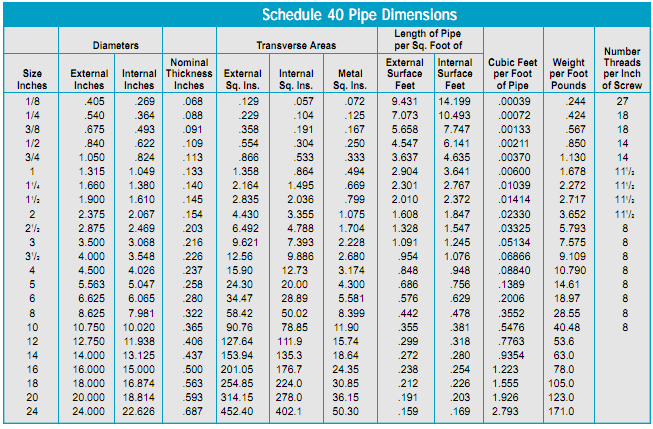 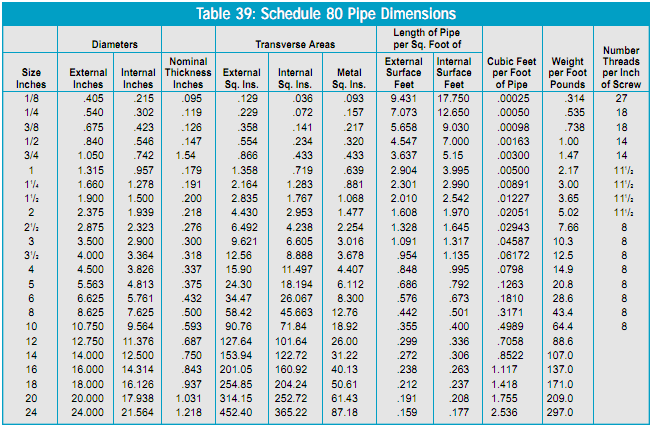
|
||||
|
|
|
||||
|
Question.
SCH 40 NPS 16 - the external diameter is 16", the internal is 15", and the nominal thickness is 0.5 inch?? If I recall my math, from 15 to 16, there's still 1 whole Inch, not half! Haha Sorry for the question, I know the answer is going to be dumb, but I really want to know. Can anybody explain? |
||||
|
|
|
||||
|
Hi Stu
To get the external diameter to make sense using the nominal pipe size and the schedule of the wall thickness you need to add the internal diameter to the schedule of the pipe, but need to count the schedule (thickness) of the pipe TWICE to get the overall diameter of the pipe... see image below. Mark |
||||
|
|
|
||||
|
Hi when we designing some network for example for gas, what is the relation between pressure and sch?
Thanks to all |
||||
|
|
|
||||
|
PVC isn't used for gas to the best of my knowledge, Check out the chart on post #10 on page one. Tom
|
||||
|
|

|
||||
|
Will 3 inch nds fittings fit 3 inch schedule 40 pipe
|
||||
|
|
|
||||
|
Why are you asking? What schedule are the fittings you wish to install? Back to you, Tom
|
||||
|
|
|
||||
|
What kind the threads NPT or BHP for sch 80
|
||||
|
|
|
||||
|
Schedule 80 PVC fittings are standard threads at NPT. A limited range of BSP threaded fittings are available.
Does this answer your question? Tom |
||||
|
|
| Question Tools | Search this Question |


Check out some similar questions!
Last year when I reported rental income from my condo Turbo Tax listed it on schedule E. This year it is putting it on Schedule C.? Isn't Schedule C for businesses?
Hi If in 2009 I had some capital gains (through stocks), do I need to file Schedule D or file Schedule NEC? Thanks
I am posted outside the US with the US government and therefore renting out my principal residence. On my 2009 return, if I deduct all the mortgage interest I paid on my house in schedule E (rental property), I won't have sufficient deductible expenses to itemize in Schedule A. If I can't itemize...
I am curious what the difference is between Schedule 40 & 80 pipe? And where/when is it used? Also if someone could also help me regarding Class 200 & Class 315 pipe, and Solvent Weld pipe I would greatly appreciate it. Thanks.
View more questions Search

|
